
Helping Children Navigate Big Feelings: A Calm Guide for Parents and Carers
Draft content notice: This is an AI-assisted sample article created for website design and demonstration purposes. It has not yet been reviewed by a qualified practitioner and should not be treated as professional mental health advice.
Strong emotions are a normal part of growing up. A child may not yet have the words or skills to explain what is happening inside them, so worry, disappointment or frustration can appear as tears, withdrawal, anger, physical complaints or changes in behaviour.
The aim is not to remove every difficult feeling. It is to help a child feel safe enough to notice it, name it and gradually learn what helps.
Begin with connection
When emotions are running high, reasoning and problem-solving can wait. Start by slowing the moment down. Use a calm voice, reduce demands where possible and let the child know you are available.
You might say:
- “I can see this feels really difficult.”
- “You do not have to explain everything straight away.”
- “We can take this one step at a time.”
Listening without rushing to fix the problem can help a child feel understood. Some children talk more easily while walking, drawing, playing or travelling in the car, where direct eye contact is not required.
Help them find words for the feeling
Naming an emotion can make an overwhelming experience feel more manageable. Offer possibilities gently rather than telling the child how they feel: “I wonder whether that felt disappointing?” or “Could there be some worry underneath the anger?”
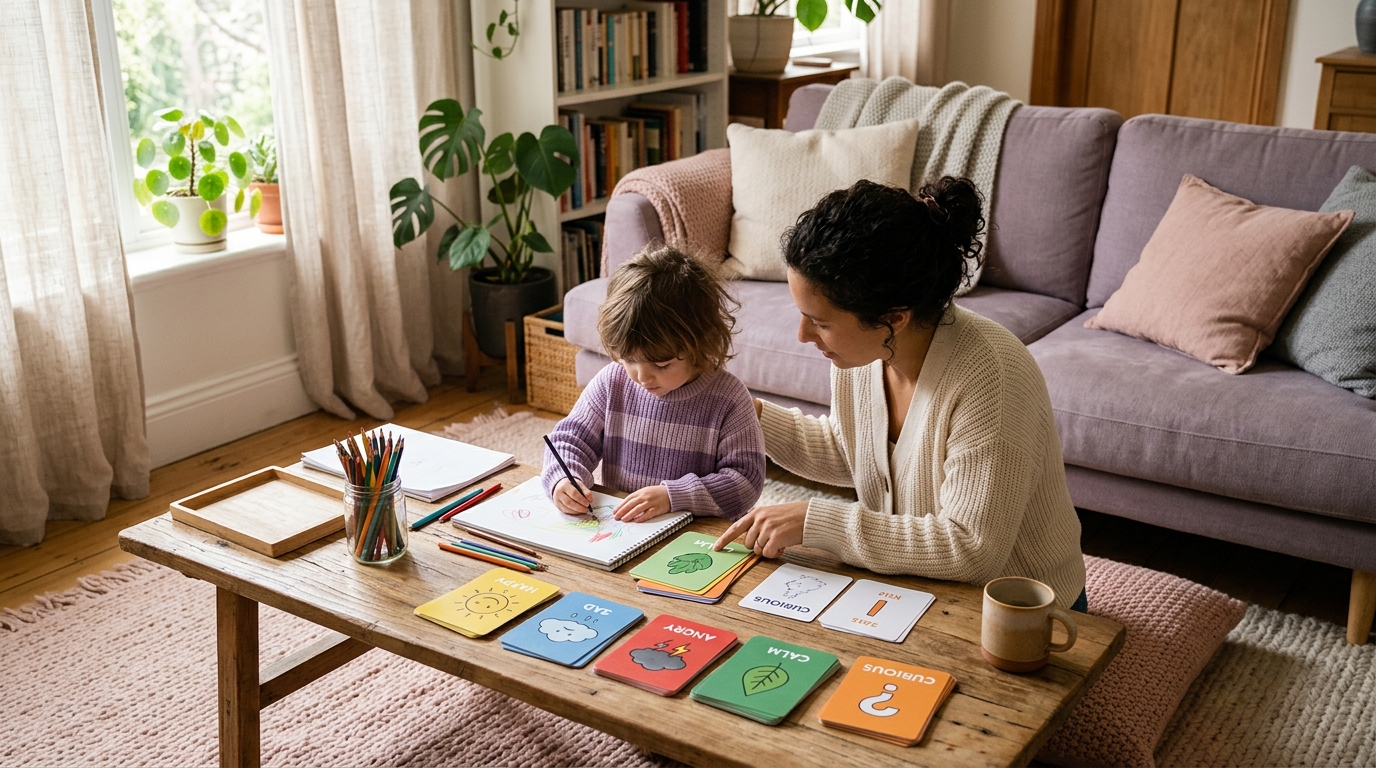
Younger children may prefer an emotions chart, colours, faces or characters. Older children might describe sensations first—such as a tight chest, hot face or unsettled stomach. There is no need to force a label; curiosity is more helpful than certainty.
Notice the need beneath the behaviour
Behaviour communicates something, especially when a child is overwhelmed. Consider what happened before the difficult moment and what the child may have needed: reassurance, rest, predictability, food, sensory space, connection or help with a task.
Understanding the need does not mean every behaviour is acceptable. Calm, consistent boundaries still matter. A useful message is: “It is okay to feel angry, but it is not okay to hurt someone. Let us find a safer way to show it.”
Build a small calming toolkit
Different strategies work for different children. Explore them during calm moments so they are familiar when needed. A toolkit might include:
- slow breathing, with a longer breath out than in;
- a drink of water or a quiet, comfortable space;
- stretching, walking or another form of movement;
- drawing the feeling or writing it down;
- holding a familiar sensory object;
- choosing one small next step together.
Avoid presenting a strategy as a command to “calm down”. Offer choices and model the activity alongside the child.
Create predictable opportunities to check in
A brief, regular check-in can make conversations feel less pressured. Try asking, “What felt easy today?”, “What felt hard?” and “Is there anything you want help with tomorrow?” A scale, colour or weather symbol can be easier than an open question.
Keep routines as steady as possible during stressful periods. Predictability around sleep, meals, school and transitions can give a child a stronger sense of safety.
When additional support may help
Consider seeking professional advice if distress is persistent, worsening or affecting sleep, eating, school, friendships or daily family life. A GP, school pastoral or safeguarding lead, or an appropriately qualified children’s mental-health professional can help you consider the next step.
If a child may be in immediate danger, contact the emergency services. This article is general wellbeing information and is not a substitute for an individual assessment.
A gentle first conversation
Every family’s situation is different. If you would like to talk through what you are noticing and explore whether Harmonical Life may be a suitable source of support, request a free 15-minute conversation.